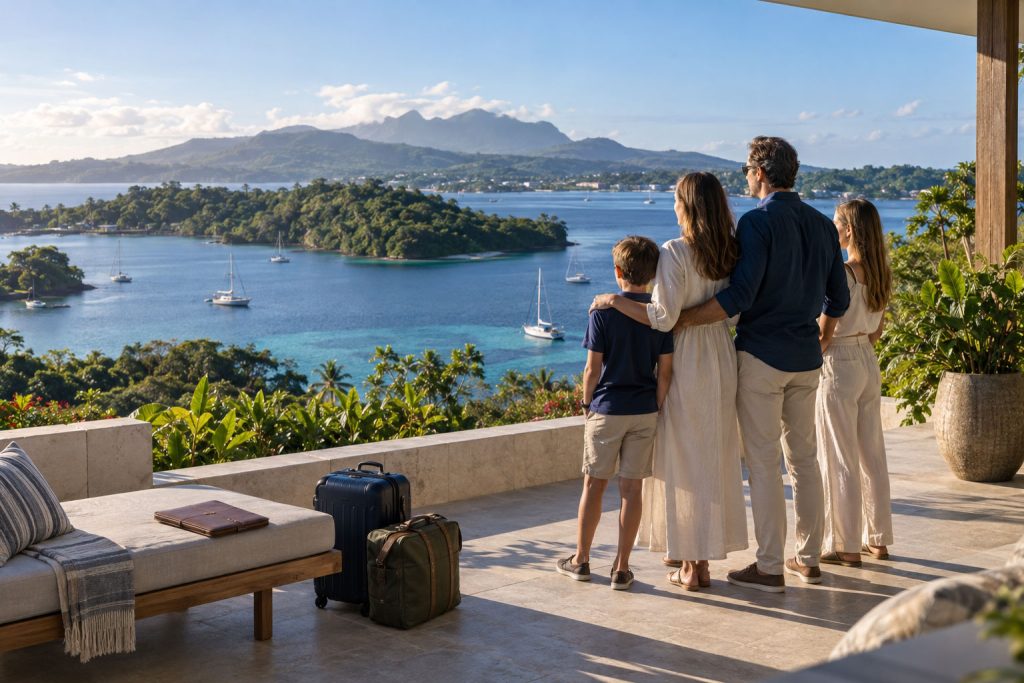
A Plan B passport is a second citizenship you acquire while you don’t need it, so that it is there if you ever do. It is insurance. Most people who hold one never use it for anything more dramatic than a quicker queue at an airport. The point is not the passport. The point is the option.
This guide is for families rather than individuals, because that is who asks us about Plan B most often and because the family dimension changes the decision. It covers what a Plan B passport actually protects against, how to think about which programme, how to structure it for children and parents, what to prepare, and why timing is the variable most people get wrong.
What a Plan B passport protects against
The phrase “geopolitical insurance” gets used a lot. In practice the risks are more specific and more ordinary.
Your home passport becomes a liability. Travel bans, sanctions regimes, visa restrictions and reciprocal retaliation between governments can make a passport that was excellent last year difficult this year. Holders of passports from countries in conflict, or subject to sudden diplomatic rupture, discover this quickly.
You cannot leave. Exit restrictions, airspace closures and border closures happen faster than most people expect. A second citizenship means a second set of consular protection and a second country that is obliged to admit you.
Your banking access narrows. Banks de-risk by nationality. A second citizenship from a jurisdiction with no such flags, with an established financial centre, keeps accounts open and gives you a second set of institutions.
Tax residency changes. Citizenship and tax residency are separate things, but a second citizenship gives you a jurisdiction you could become resident in if you ever needed to. Vanuatu has no personal income tax, no capital gains tax, no inheritance tax and no wealth tax.
Your children’s options are limited by your passport. A hereditary second citizenship gives the next generation choices you did not have.
None of these is likely for any given family in any given year. All of them are possible over a lifetime. Insurance is bought for exactly that kind of risk.
What a Plan B passport does not do
It does not change your tax obligations at home. If you are a US citizen, you remain taxed on worldwide income wherever you live and whatever other passports you hold. It does not by itself give you the right to live in any third country. It does not, in Vanuatu’s case, give you visa-free access to Europe or the UK. Anyone who tells you otherwise is selling, not advising.
Choosing the programme: what matters for a family
For an individual, the choice is mostly about price and mobility. For a family, three other things matter more.
Family inclusion at a fixed price. Some programmes price each dependent separately, which can double the headline cost for a family of four. Vanuatu’s Capital Investment Immigration Programme includes the principal applicant, spouse and two children under 18 for a single price of $165,000, of which $50,000 is returned after four years. That is the same price a single applicant pays.
Hereditary citizenship. A Plan B passport for a family is only worth having if it passes to children born after you obtain it, and to their children. Vanuatu citizenship is hereditary by descent. Not every programme’s is; residency-by-investment schemes in particular usually are not.
Speed and remoteness. A family application involves more documents, more police clearances and more people who need to attend a biometric appointment. A programme that takes eighteen months and requires a visit to the country is a different undertaking from one that takes as little as 45 days and is managed remotely.
The DSP vs CIIP guide sets out how the two Vanuatu programmes compare for different family sizes, and the cost calculator gives you an exact figure.
Structuring it: who to include and when
Include the whole family in one application. It is cheaper, faster and simpler than adding dependents later. On Vanuatu’s CIIP a family of four is one price; on the DSP a spouse is $20,000 and a child under 18 is $15,000.
Children aged 18–25 can be included where they are in full-time education. If you have a child approaching 18, the timing of the application matters.
Dependent parents can be included: aged 50 or over on the CIIP, 55 or over on the DSP. For families with elderly parents in a country whose passport is becoming difficult, this is often the most important part of the application.
Children born after the grant acquire citizenship by descent. You do not need to plan for them; the citizenship does that for you.
Children who are not yet born but planned are a reason to apply sooner rather than later, because citizenship by descent flows from a parent who already holds it.
What to prepare in advance
Even if you are not ready to apply, a family that has done the following can move in weeks rather than months when it decides to.
Keep every family member’s passport valid with at least 18 months to run. Hold certified copies of birth and marriage certificates. Know which countries each adult has lived in for more than a year over the last decade, since police clearances will be needed from each. Keep bank statements and a clear record of source of funds; the due diligence process will ask where the money came from, and a clean, documented answer is the single biggest accelerator. Maintain a current CV for each adult.
None of that is onerous. All of it takes longer than you think when you are in a hurry.
Why timing matters more than price
The mistake families make is waiting for the reason.
Insurance bought after the event is not insurance. A family that applies once a border has closed, a sanctions list has been published or a bank has sent a closure letter will find that the same events that motivated the application also complicate it: police clearances become harder to obtain, funds become harder to move, and programmes tighten their nationality rules in response to the same news. Nauru, for example, now excludes anyone born in Russia or Belarus; it did not when it launched.
The cost of a Plan B passport is broadly stable. The availability of one to your family is not. The right time to apply is when you don’t need it, and the process is straightforward.
A family example
A couple in their forties with two children aged 12 and 15, holding passports from a country whose visa-free access has been narrowing. They apply for Vanuatu’s CIIP. Total cost $165,000, of which $50,000 is returned after four years, so an effective $115,000 for four citizenships. The application is prepared and lodged remotely; the family attends a biometric appointment in Dubai. Citizenship and passports are issued in as little as 45 days. Both children hold hereditary citizenship for life, as will their children. The parents’ $50,000 sits in the Vanuatu Impact Fund, supporting 300+ farmers and 3,000+ farming families growing coffee, cacao, vanilla and kava, and comes back with any returns.
If nothing ever goes wrong, they have four extra passports, tax-free citizenship of a stable Commonwealth country, and $50,000 back. If something does, they have somewhere to go.
Frequently asked questions
What is a Plan B passport?
A second citizenship acquired as insurance against risks to your first: travel restrictions, exit restrictions, banking de-risking, political change.
Which is the best Plan B passport for a family?
It depends on budget, family size and where you travel. For families, look for fixed family pricing, hereditary citizenship, speed and a remote process. Vanuatu’s CIIP scores well on all four.
Can I include my parents?
On Vanuatu’s programmes, dependent parents can be included: aged 50 or over on the CIIP, 55 or over on the DSP.
Do my future children get citizenship?
Yes. Vanuatu citizenship passes by descent to children born after the grant.
How long does it take?
As little as 45 days from application to passport with Vanuatu. Caribbean programmes take six months or more; some European ones over a year.
Does a second passport affect my taxes at home?
Not by itself. Citizenship and tax residency are separate. Take advice in your home jurisdiction.
Next step
The eligibility quiz takes two minutes and tells you which programme fits your family. If you would rather talk it through, book a consultation with one of our senior advisers. No fee, no commitment, and a candid answer on whether a Plan B passport is right for you and, if so, which one.
 +678 756 6666