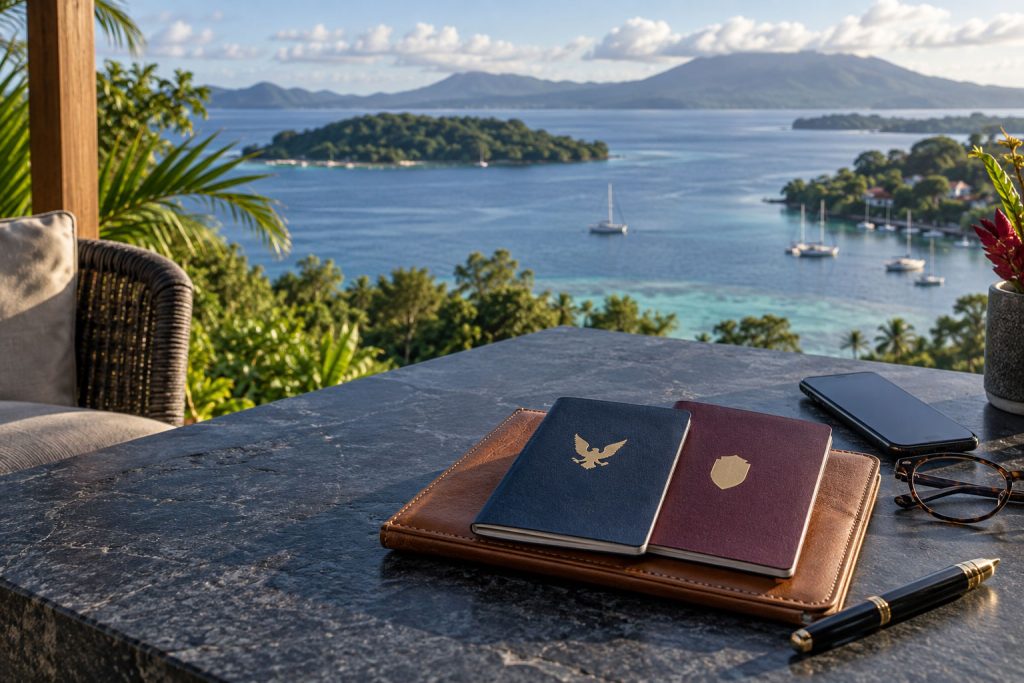
Americans are now one of the fastest-growing groups applying for second citizenship, and Stanford Knight’s US client base has grown with them. The reasons are practical: political volatility at home, a desire for optionality abroad, banking friction, and for a growing number, digital-asset wealth that they want to hold in a jurisdiction that does not tax it.
Most of what is written for this audience is either hype or fear. This guide is neither. It explains what a second passport does and does not do for a US citizen, where the tax line actually sits, why the second passport is the prerequisite for the only real tax exit, and which programmes fit.
General information, not legal or tax advice. US tax law is complex and personal; take advice from a US-qualified adviser.
Yes, Americans can hold a second passport
The United States permits dual and multiple citizenship. You do not lose US citizenship by acquiring another, provided you do not intend to relinquish it. You must enter and leave the US on your US passport, and you continue to be treated as a US citizen for all US purposes wherever you are. That is the whole of the legal position.
Vanuatu, for its part, permits dual citizenship and does not notify your home country when you become a citizen.
What a second passport does not do for Americans
It does not reduce your US tax. The US taxes its citizens on worldwide income regardless of residence. A US citizen living in Vanuatu on a Vanuatu passport still files a US return, still reports foreign accounts under FBAR and FATCA, and still owes US tax on capital gains, including crypto, subject to the foreign earned income exclusion and foreign tax credits. No second passport changes that. Anyone selling a second citizenship to Americans as a tax solution is selling something that does not exist.
It does not improve your travel much. The US passport is one of the strongest in the world. A Vanuatu passport reaches 100+ countries and territories, but the US passport already reaches almost all of them and more. There are a handful of exceptions, Russia among them, where the Vanuatu passport is more convenient, but mobility is not the reason an American buys one.
What it does do
Optionality. A second citizenship is a second country obliged to admit you, a second consular relationship, and a second set of institutions. In a decade when Americans have watched their own institutions become less predictable, that is the core of the case.
Banking. US citizens are routinely refused accounts abroad because of FATCA compliance costs. A second passport does not remove your FATCA obligations, but it does open institutions that would not otherwise deal with you, and it gives you a second jurisdiction with its own banking sector. Vanuatu’s is regulated, English-speaking and crypto-literate.
Hereditary citizenship for your children. Vanuatu citizenship passes by descent. Your children and their children hold a second nationality for life without having to buy one.
A place to become resident if you ever want to. Citizenship and tax residency are different things, but citizenship gives you a country you are entitled to live in. Vanuatu has no personal income tax, no capital gains tax, no inheritance tax and no wealth tax. For an American that only matters if you do the one thing below.
The one real tax exit, and why it starts with a second passport
The only way for a US citizen to stop being taxed on worldwide income is to renounce US citizenship. The US will not let you do that unless you already hold another citizenship, because it will not render anyone stateless. A second passport is therefore not a tax strategy in itself; it is the precondition for the only tax strategy that works.
Renunciation is a serious decision with a serious price: an exit tax on unrealised gains for covered expatriates, a $2,350 fee, an appointment at a consulate, and the loss of the right to live and work in the US without a visa. Most people who acquire a second passport never renounce. But a meaningful minority do, and every one of them needed the second passport first.
If renunciation is on your horizon, even as a possibility, the order of operations is: second citizenship, then tax residency planning, then the exit. Vanuatu’s 45-day timeline makes it the fastest way to complete step one.
Which programmes fit Americans
Vanuatu. The fastest and cheapest of the established programmes: $135,000 on the DSP or $165,000 on the CIIP with $50,000 returned. As little as 45 days, fully remote, no interview, hereditary. Zero-tax jurisdiction if you ever become resident. Payment in USDT and USDC accepted, which matters to a large share of US applicants. No Schengen or UK access, which for an American is irrelevant.
Caribbean programmes (St Kitts, Antigua, Grenada, Dominica, St Lucia). Around $250,000–300,000 all-in, six months or more, stronger passports with Schengen access that an American does not need. Grenada’s US E-2 treaty is the one feature with specific US relevance, and only for those who have renounced.
European programmes (Malta). Over a million dollars and a year or more. Full EU rights, which is the only reason to pay that much.
Nauru and São Tomé. Around $90,000–130,000. Newer, slower, and with weaker banking acceptance. Reasonable as a pure backup; less useful if banking is part of the goal.
For most Americans whose objectives are optionality, banking and a fast, clean second citizenship, Vanuatu is the obvious fit. For those who specifically want EU residence rights, it is not.
Practical points for US applicants
Police clearances come from the FBI (an Identity History Summary) and, where you have lived abroad, from those countries. Source-of-funds documentation is required as for any applicant; US tax returns are usually the simplest evidence. Biometric capture for the Vanuatu passport can be done in Dubai, Hong Kong, Nouméa or Port Vila; most US clients use Dubai or combine it with travel. You do not need to travel to Vanuatu. You must continue to use your US passport to enter and leave the United States.
Frequently asked questions
Can a US citizen legally have a second passport?
Yes. Dual citizenship is permitted.
Will Vanuatu citizenship reduce my US taxes?
No. US citizens are taxed on worldwide income wherever they live and whatever other passports they hold.
Does the US find out?
Vanuatu does not notify the US. You have no obligation to tell the State Department, although you must use your US passport for US travel.
Can I renounce US citizenship with a Vanuatu passport?
Yes. Holding another citizenship is a precondition for renunciation.
How long does it take?
As little as 45 days from application to passport.
Can I pay in crypto?
Yes. USDT and USDC are accepted, subject to source-of-funds checks.
Next step
If you are an American weighing a second citizenship, book a consultation. We will tell you plainly what Vanuatu does and does not do for a US citizen, and if another programme suits you better we will say so.
 +678 756 6666