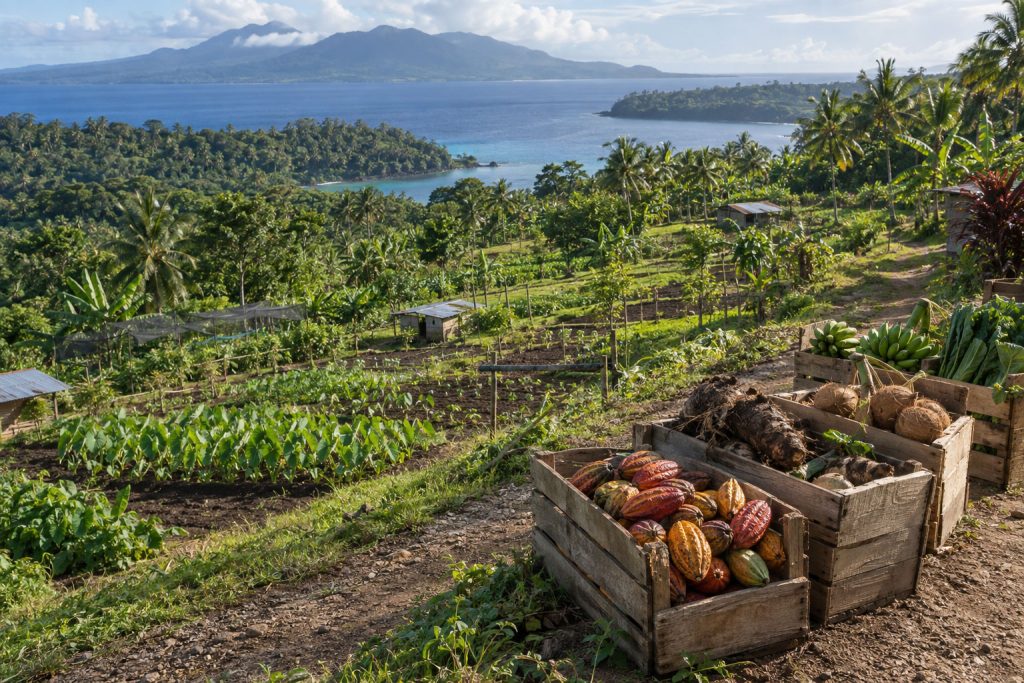
The Vanuatu Impact Fund: Citizenship That Supports 300+ Farmers
Most citizenship by investment programmes ask you to donate. The money goes into general government revenue, you receive a passport, and that is the end of the relationship.
Vanuatu’s Capital Investment Immigration Programme works differently. $50,000 of your contribution is invested in the Vanuatu Impact Fund, deployed across smallholder farms on 83 islands, and returned to you after four years together with any investment returns. You get citizenship, your capital back, and an annual report telling you what it did while it was away.
This article explains how the fund works, what it invests in, who runs it, what the risks are and how it fits into the citizenship application. Stanford Knight is the exclusive Master Agent for the fund, so we know it well.
One fund, four crops, the whole country
The fund launched in 2024 as the Vanuatu Coffee Impact Fund, focused on organic Arabica grown on the volcanic soils of Tanna Island. It is now the Vanuatu Impact Fund, approved to operate across Vanuatu’s primary sector nationally. The investment structure has not changed; the mandate has widened.
Coffee. Tanna’s volcanic soils, enriched by Mount Yasur, produce some of the Pacific’s highest-quality organic Arabica. It remains the fund’s founding sector and its deepest.
Cacao. A long-established Vanuatu export with rising specialty demand. Fermentation and drying infrastructure lifts smallholder margins directly.
Vanilla. High value per hectare and well suited to smallholdings. Curing quality is the constraint, and the constraint is investable.
Kava. One of Vanuatu’s leading exports and a mainstay of rural income. Processing, grading and traceability are the growth path.
Spreading capital across four crops, dozens of islands and different harvest seasons means it is never exposed to a single crop failure, cyclone or price cycle. That diversification is the practical basis of the fund’s capital preservation policy.
Who it reaches
The fund currently supports more than 300 smallholder farmers and reaches over 3,000 farming families. Vanuatu’s agriculture is overwhelmingly smallholder and overwhelmingly organic by default; most farms are two to five hectares, family-run, and have never used synthetic inputs. What they lack is processing infrastructure, quality certification and access to premium export markets. That is what the fund pays for.
Your investment supports sustainable organic farming, rural job creation, environmental conservation, fair trade practice and local economic development. Those are not slogans; they are the line items in the impact report you receive each year.
How the investment works
Year 0. You invest $50,000 in the fund as part of your CIIP application. Redeemable preferential share certificates are issued to you in the fund holding company. There is no requirement to register a separate company.
Years 1–4. Capital is deployed across coffee, cacao, vanilla and kava nationally. Fund reports are produced regularly, including independent annual impact reporting setting out where your capital went and what it achieved.
Year 4. The fund manager contacts you to arrange redemption of your investment together with any returns. Your effective cost of citizenship becomes $115,000.
The fund is professionally managed by independent fund managers, with all primary-sector investment made as mandated by the Government of Vanuatu under a capital preservation policy targeting a feasible 5–6% per annum.
What “redeemable” means, and what it doesn’t
Two things need saying plainly, because they come up in almost every conversation.
The four-year term is fixed. The fund operates on a four-year cycle and capital is committed for the full term. You cannot redeem early. If you might need the $50,000 within four years, the DSP is the better programme for you.
“Redeemable” is not “guaranteed.” Your $50,000 is returned at the end of the term under a capital preservation policy, and the fund targets 5–6% per annum. Like any investment, it carries risk, and the fund’s documents say so. That disclosure does not contradict your redemption rights; it is the standard language of a properly regulated investment. If an agent tells you the return is guaranteed, they are misdescribing the fund.
The numbers
Amount
Programme cost (government fees and due diligence)
$115,000
Vanuatu Impact Fund investment, redeemable after four years
$50,000
Total, single applicant to family of four
$165,000
Effective cost after redemption
$115,000
Beyond a family of four: additional child under 18
$20,000
Beyond a family of four: child 18–25 in full-time education
$25,000
Beyond a family of four: dependent parent aged 50+
$25,000
Stanford Knight charges no agent fee, no advisory fee and no processing fee. We are paid by the Government of Vanuatu.
Who is behind it
The Chairman of the Vanuatu Citizenship Commission, Charles Maniel, has described investing through the CIIP in Vanuatu’s primary sector as a visionary step towards the nation’s prosperous and sustainable future, and the Impact Fund as a critical part of that vision.
The fund is managed by Samuel Tiwok, an agronomist who has worked with Vanuatu’s smallholder sector for years and who knows the farmers the fund supports by name. The fund passed its government audit in 2025. Stanford Knight is the only agent authorised to offer CIIP through it.
Why the government structured it this way
Vanuatu’s economy is built on tourism, offshore services and primary exports: kava, beef, copra, cacao and coffee. Citizenship revenue is significant, and the government wanted a portion of it to build productive capacity rather than simply fund the budget. The CIIP is that mechanism. Every application channels $50,000 into rural infrastructure that outlasts the investment term, and every investor receives the capital back, so the cost to the applicant is lower than the DSP while the benefit to the country is higher.
It is, as far as we know, the only citizenship programme in the world where the investor, the government and the rural poor all come out ahead.
How it fits into your application
The Impact Fund investment is made at lodgement, alongside the government fees, and is handled entirely within the CIIP application. The process is the same seven steps and as little as 45 days as the DSP. You do not need to travel, register a company, or do anything beyond signing the subscription documents we prepare. Share certificates are issued on citizenship approval and the fund manager takes it from there.
Frequently asked questions
Is the Vanuatu Impact Fund the same as the Coffee Impact Fund? Yes. The fund launched as the Vanuatu Coffee Impact Fund in 2024 and was renamed when its mandate expanded to cacao, vanilla and kava nationally.
Can I get my $50,000 back early? No. Capital is committed for the full four-year term.
Is the return guaranteed? No investment return is guaranteed. The fund operates under a capital preservation policy and targets 5–6% per annum.
Do I need to set up a company? No. You receive redeemable preferential shares in the fund holding company.
What do I receive during the four years? Regular fund reports and an independent annual impact report.
Who can invest? Only CIIP applicants through Stanford Knight & Partners and its authorised marketing partners.
Vanuatu runs one of the fastest, simplest citizenship by investment programmes in the world. There is no residency requirement, no interview, no language test and no need to travel to Vanuatu during the application. Processing takes...
Over the past three years Stanford Knight has seen a threefold increase in families seeking a credible second citizenship. That is consistent with what the whole industry reports: new programmes launching, established programmes raising prices, and...
 +678 756 6666